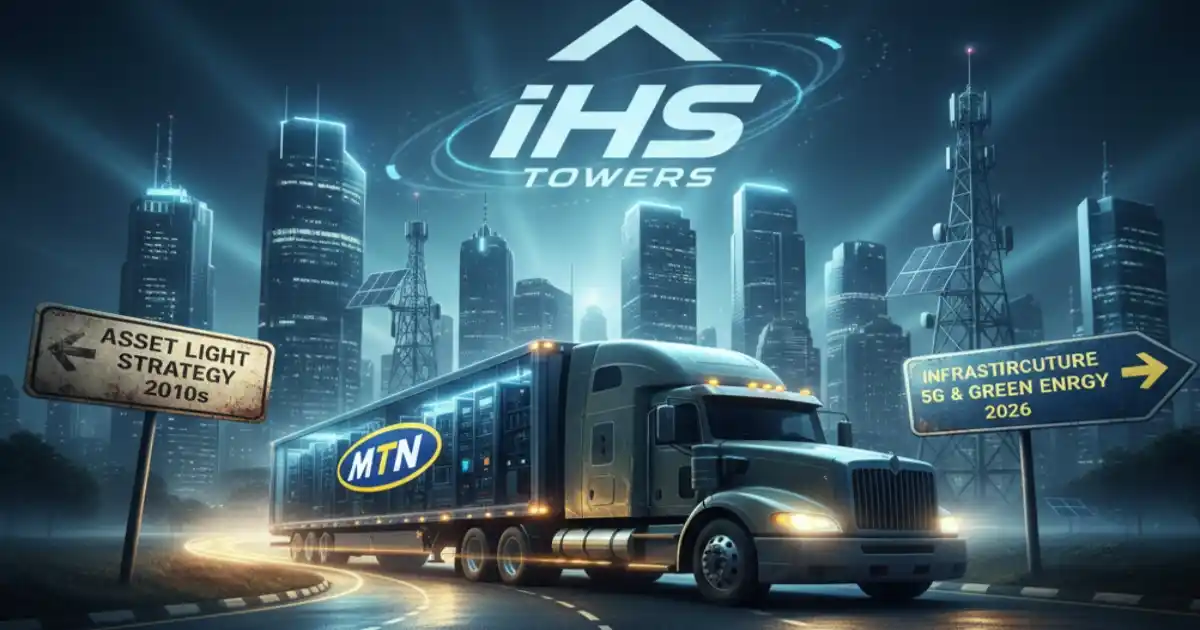
The telecommunications industry in Africa has just witnessed one of its most significant strategic pivots in decades. On February 5, 2026, MTN Group, the continent's largest mobile operator, confirmed it is in advanced, non-binding discussions to acquire the remaining 75% stake in IHS Holdings (IHS Towers) that it does not already own. Valued at approximately $2.76 billion, based on a share price of $8.23, the deal represents more than just a massive financial transaction it is a total philosophical reversal of the "asset-light" strategy that dominated the 2010s.
For years, the industry mantra was to sell off physical infrastructure and focus on "the glass" the software, the data, and the customer experience. Now, in a world of high energy costs and complex 5G rollouts, MTN is betting that owning the ground is the only way to secure its future.
The Genesis of the Asset-Light Strategy
To understand why this is a "U-turn," we must first look at why MTN sold its towers in the first place. Between 2010 and 2022, global telecommunications shifted toward a model known as asset-light. The logic was simple: towers are expensive to build, maintain, and protect. They are essentially "dumb" steel and concrete. By selling these towers to independent tower companies (Towercos) like IHS Towers or American Tower, mobile operators could:
- Unlock Capital: Selling thousands of sites provided a massive cash injection to pay down debt or bid for expensive new spectrum.
- Reduce Balance Sheet Intensity: Removing physical assets improved financial ratios, making the companies more attractive to tech-focused investors.
- Operational Focus: Letting a specialist manage the power, security, and maintenance of the sites allowed the telco to focus purely on network quality and digital services.
MTN was a pioneer of this move. In markets like Nigeria and South Africa, it entered into massive sale-and-leaseback agreements. As recently as 2022, MTN South Africa sold over 5,700 towers to IHS in a landmark deal. However, the lease payments that replaced the maintenance costs have now become a massive, inflexible burden on MTN’s bottom line.
The Friction Points: Governance and Shareholder Spats
While the financial logic of leasing initially held up, the relationship between MTN and IHS began to sour behind the scenes. This $2.76 billion move is as much about corporate governance as it is about infrastructure.
Throughout 2023 and 2024, a public and messy power struggle erupted. MTN, which holds a 25% economic stake in IHS, argued that its voting rights were being unfairly capped at 20% by the IHS board. MTN, along with other major shareholders like Wendel SE, sought greater representation on the board to reflect their actual investment. IHS management resisted, citing the need to remain an "independent" provider fearing that if MTN had too much control, other tenants (like Airtel or Glo) would move their equipment to rival towers to avoid giving MTN insight into their network coverage.
The tension reached a boiling point when MTN Nigeria began awarding tower contracts to American Tower (ATC) instead of renewing with IHS. This "war of the towers" signaled that the partnership was broken. By buying IHS outright, MTN is effectively saying: "If you won't let us vote, we'll just buy the whole room."
The Details of the Deal
- The Stake: MTN already owns roughly 25% of IHS. They are now in advanced, non-binding talks to acquire the other 75%.
- The Valuation: Based on IHS’s closing price on the New York Stock Exchange ($8.23 per share), the deal is worth about $2.76 billion.
- The Goal: Moving from a "renter" to an "owner" to gain full control over the physical backbone of their network.
Why Is MTN Doing This Now?
This isn't just a random shopping spree; it's a calculated move to solve three major headaches:
- The 5G Push: 5G requires many more towers and much closer integration between the hardware and software. Owning the towers makes the 5G rollout faster and cheaper.
- The Power Problem: In markets like Nigeria, towers are notoriously expensive to run because they rely on diesel generators. By owning the towers, MTN can directly invest in green energy (solar and batteries) to slash operating costs.
- Strategic Friction: MTN and IHS have had public disagreements over corporate governance in recent years. Buying the company out ends the "landlord-tenant" drama once and for all.
"Will This Stifle Competition or Nah?"
This is the big question raised in the TikTok post, and the answer is: It’s a very real risk.
The Energy Imperative: Why Diesel is Killing the Renter Model
Perhaps the most practical reason for the U-turn is energy. In Africa, particularly in Nigeria which accounts for nearly 60% of IHS's revenue towers do not run on a stable national grid. They run on diesel generators.
Under the leaseback model, the tower company (IHS) is usually responsible for the power. However, with global fuel prices fluctuating wildly and the Naira's volatility, the cost of "renting" power has become unpredictable.
- The 5G Problem: 5G equipment consumes 2 to 3 times more energy than 4G.
- The Solar Transition: For MTN to meet its "Project Zero" sustainability goals and lower operating costs, it needs to aggressively move towers toward solar and battery storage.
When you rent a tower, you are at the mercy of the landlord's investment timeline. By owning the towers, MTN can directly invest its own capital into green energy solutions, cutting out the middleman’s margin and insulating itself from future fuel price shocks. For a network of MTN's scale, saving even 10% on energy across 40,000 towers translates to hundreds of millions of dollars in annual EBITDA.
The 5G Roadmap: Control is the New Currency
As we move deeper into 2026, the complexity of network deployment has changed. 5G is not just a "faster 4G"; it requires a much denser network of sites.
- Site Density: 5G signals travel shorter distances, meaning operators need "small cells" and more tower locations.
- Network Slicing: To offer specialized services to mines, factories, and hospitals, the software and the physical hardware need to be perfectly synchronized.
Managing this through a third-party landlord creates strategic friction. Every time MTN wants to add a new 5G antenna or upgrade a cabinet, it must negotiate terms with IHS. In a high-speed competitive market, these delays are unacceptable. Ownership provides the operational agility required to win the 5G race in Africa.
"Will This Stifle Competition or Nah?"
The TikTok post by Bayomi hit the nail on the head: Is this deal good for the consumer?.
|
Potential Impact |
Description |
|---|---|
|
The Monopoly Concern |
IHS is the largest independent tower operator in Africa. If MTN owns them, they also control the physical sites that their competitors (like Airtel) rent. |
|
Pricing Power |
Regulators fear MTN could raise the "rent" for other telcos or prioritize its own equipment on the best towers. |
|
Regulatory Hurdles |
The NCC (Nigeria) and the JSE (South Africa) will likely demand strict "fair access" rules before approving the deal. |
The concern is monopoly power. If MTN owns the dominant tower infrastructure in Nigeria and South Africa, they become the "landlord" for their biggest rivals.
- The Threat: Regulators like the Nigerian Communications Commission (NCC) are wary that MTN could prioritize its own equipment on prime towers or raise lease rates for competitors like Airtel Africa.
- The Defense: MTN argues that by consolidating the infrastructure, they can achieve "economies of scale" that actually lower the cost of data for everyone. Furthermore, they may be forced by regulators to maintain a "neutral host" policy, ensuring that competitors are treated fairly even under MTN ownership.
Financial Analysis: $8.23 and the "Distress Zone"
The $2.76 billion valuation is a strategic play on a depressed stock price. IHS Holdings has struggled on the New York Stock Exchange, with its share price recently sitting at $8.23. Analysts have pointed out that IHS has a high debt load and an Altman Z-Score in the "distress zone" a metric suggesting a higher-than-average risk of financial trouble if the market doesn't improve.
By stepping in now, MTN is performing a vulture-like rescue mission that benefits both parties:
- For IHS: It provides an exit for frustrated shareholders and integrates the towers into a company with a massive, guaranteed cash flow.
- For MTN: It converts a massive operating expense (Opex) the monthly rent into capital expenditure (Capex) that builds long-term equity.
Conclusion: The End of the Outsourcing Era
The $2.76 billion U-turn marks the end of the "asset-light" honeymoon in African telecoms. It is a bold admission that in developing markets with volatile currencies and power shortages, infrastructure is too important to be left to third parties.
MTN is no longer just a "mobile network operator"; it is evolving into an integrated infrastructure giant. If the deal closes, the landscape will be forever changed. Competitors will likely follow suit, or find themselves perpetually paying rent to their biggest rival.